Unit of Inquiry
PYP Exhibition
In Kansai International Academy’s exhibition, G6 students choose their own topic, build their own stream of inquiry, and present the results of their research and collection of materials using ICT and various other tools. The students will share their passions by incorporating various disciplines such as history, science, math, programming, presentations, and culture. They are also encouraged to raise social issues, introduce new ideas, and share their thoughts with their parents and teachers, while being aware that they will become members of society.
The PYP Exhibition is also a place to celebrate each student’s learning and growth. We hope that everyone who attends the exhibition will have the opportunity to watch and listen to the children’s learning as well as to learn and think together about local and global issues.
Student Led Conference
The Student Led Conference (SLC) is one of the ways IB proposes for students to assess and share their learning. It is a culmination of the year’s learning where the students share and reflect on their own learning over the year while engaging in conversations and activities with their families and other people.
The SLC is implemented in a variety of ways depending on the school and each student, and is full of individuality. In our school, we usually set up individual student booths in each corner of the classroom to reflect on the year’s learning in each unit as the learning is organized into six units throughout the year.
Families will be invited into their children’s classrooms to share content carefully selected by the children themselves with their parents through student-led presentations and games.
The main purpose of this event is for families to take the time to see the children’s daily efforts and the growth they have made throughout the year, and for parents to express their feelings to their children in concrete words.
ELA
Each student has different needs when it comes to developing English language skills. To meet these needs, Kansai International Academy has developed an English curriculum that integrates English Language Arts (ELA) and English as a Second Language (ESL). Homeroom teachers and full-time ESL teachers work as a team to teach the basic language structures necessary for English language development, including phonics, spelling, reading, writing, speaking, listening, grammar, and fluency development. In addition, once a week, one ESL teacher is assigned to each group of four students to provide individualized pronunciation instruction and encourage confidence in speaking by creating more opportunities to speak in small groups.
Kansai International Academy has developed a unique ELA/ESL curriculum that combines the English learning guidelines of the IB PYP with the ESL curriculum supervised by Cambridge University. This unique English curriculum is designed not only to help students learn English, but also to help them master the language in relation to other areas of study in English. In particular, it helps students to expand their vocabulary and language skills necessary for inquiry learning, allowing them to delve deeper into concepts and enrich their overall learning. The program is designed to help the students acquire the vocabulary and language skills necessary for inquiry learning.
English Proficiency Test
The Elementary School has adopted the Cambridge Exam as a means of improving the English curriculum and assessing each student’s English ability.
In addition to the MAP Growth, which is required for all students, we also have an optional TOEFL Junior and TOEFL Primary Step 2 on campus.
| MAP Growth | Every Students | Twice a year per Term | Require |
| TOEFL Primary Step 2 | G1-3 | Jul. / Jan. | Any |
| TOEFL Junior | G4-6 | Jul. / Jan. | Any |
English Events
- Summer School
- Recitation Olympic
- Speech Contest
- School Production
- Spelling Bee
- Study Abroad in NZ
Speech Contest
The speech contest is held every year for G4 students and above. They create a presentation based on a theme and give a TED Talk style presentation in front of their friends and parents. In the past, the students have participated in the speech contests with themes such as creativity, leadership, empathy, respect, honesty, and confidence. They write their speeches, proofread each other’s, prepare and practice their presentations, and then present them in the black box theatre.
The experience of the speech contest will not only improve the students’ presentation making skills and English speaking skills, but also help them improve their writing skills, use ICT skills in their presentations and most importantly, build their confidence.
Japanese
Kansai International Academy, which is committed to bilingual education, focuses on the acquisition of Japanese language skills as well. While adopting the guidelines of the Japanese Courses of Study, basic skills in kanji, grammar, reading and writing are integrated with units of inquiry learning.
We implement “Writer’s Time” as part of our approach to motivating students to write and cultivating their expressive abilities. Unlike compositions with a fixed theme, students express what they want to write about in the way they want to write it.
They follow the “writer’s cycle” of gathering materials for what they want to write, drafting, revising, proofreading, and publishing their work. The students’ works are published in a monthly publication called “Writer’s Time,” which can be picked up and read by students in any grade.
Works by students from G1 through 6 are collected for the “Writers’ Award,” which is held annually as the culmination of the “Writers’ Time” cycle. The best works of the “Writers’ Awards” are actually bound and donated to the library, where students of the elementary school enjoy them.
Mathematics
Both International and Japanese homeroom teachers teach Math in English and Japanese. Dividing students into smaller groups, we aim students to understand concepts of Math in both languages. Our Math class is a part of integrated study, which involves inquiry based learning units. At KIA, we structure our original curriculum by assembling guidelines from Japanese governments and IB (PYP). It covers basic Math units, and moreover we aim students to apply their knowledge into other subjects in both languages.
“Todays’ Math was difficult, but I understood by listening to others’ explanations.” “I feel I can become a clock master. I want to learn more about clocks!” (from G3 Math Unit: time)
These are reflections written by students. At KIA, we encourage students to learn from each other.
We tend to be biased by the word Math, such as “being fast at calculations” or “knowing formulas”. However, we focus more on “to think and enjoy Math through communication”, rather than “receiving high scores in Math”.
Our math class is driven by students’ interest. For example, leading to a circle unit by thinking about the fairness of the bean bag toss game, or making shapes on geoboards before talking about areas. We always have students communicate with others by involving the essence of inquiry based learning.
Students are ready to write reflections after inquiry based Math class. They express their findings through diagrams and words. These don’t include any simple comments like “It was fun. I want to do it again”. When students get to think deeply in class, they get to reflect in depth, allowing them to developing their capacity to think.
Performing Arts
The performing arts program at Kansai International Academy is not limited to drama, music, and dance, but also includes language arts and visual arts, with the aim of allowing students to fully explore and acquire their own unique way of expression.
School Production
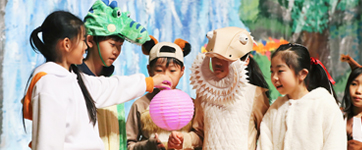
The KIA Musical Production is a musical performance that the entire school comes together to create. It started its history in 2015 as the Winter Celebration and has continued to grow as an opportunity for the students to express their creativity. The stage performances are held in the fall and winter, but the preparation for the production takes about half a year.
Grade 1 through 3 students mainly learn to enjoy being on stage, express themselves in front of others, watch, support and learn from their friends’ performances. Students at this age immerse themselves in the performance with their whole bodies and will demonstrate a uniquely natural expression.
Grade 1 through 3 students mainly learn to enjoy being on stage, express themselves in front of others, watch, support and learn from their friends’ performances. Students at this age immerse themselves in the performance with their whole bodies and will demonstrate a uniquely natural expression.
Students from grade 3 and above can audition to be a narrator who connects the storyline throughout the performance.
In addition, grade 4 to 6 students audition to join one of the following teams: director, producer, actor, dance choreographer, makeup/costume designer, stagehand, sound maker, or script writer.
For the stage design, some of the students’ background designs are selected in a contest and appear on stage as a huge 5m x 9m backdrop. The backdrops are handmade by volunteers from the parents and guardians, and staff; as well as painted by the students during the summer school. The experience of having their work appear as a backdrop on a large stage has been a great confidence builder.
In addition, the skills needed to create the stage performance are designed to connect to the units of inquiry of the class. For example, in one grade level unit on “Decision Making,” students explore how decisions should be made as individuals and as an organization when creating their performance.
Through collaborative work with teachers, parents, and other adults beyond the classroom and grade level, students develop social skills as they think, help, and encourage each other to create a single product together. We believe that the most important outcome of the Musical Production is not only the performance, but also the learning and confidence gained through the process.
ICT
The use of ICT is a core element of Kansai International Academy’s interdisciplinary curriculum. In order to deepen their own learning, the students make full use of their ICT skills. This requires the students not only to be able to use the devices, but also to think and learn on their own about how to use them effectively and how to acquire those skills. Our school rents iPads to the students from the first grade onwards. iPads are used in many aspects of daily learning, such as collaborating on assignments, creating, researching, designing, programming, and sharing documents and other materials that they have created with others.
Our elementary school also focuses on programming and robotics from the first grade. We believe that ICT classes and the use of ICT skills will develop children’s creativity and problem-solving skills, which will lead each student to deepen their overall learning and express what they have learned in a variety of ways.
The elementary school ICT curriculum at KIA has been built as a 6 year plan that guides the students through basic skills such as understanding how to hold and take care of their device, how to keep their private data safe, early programming skills, using effective techniques when searching for information on the internet and other important skills. If you see the chart below, you can see the 8 areas that we introduce students to:
At Kansai International Academy, we integrate ICT not as a special skill to teach, but as an integral part of everyday inquiry learning, math, and language.
As each student in every grade learns with an iPad, students will find it natural to use ICT in their daily lives and learning.
Students can take photos of their classmates’ work on their iPads and compare and evaluate each other’s work on the monitor. They can also design posters and other works simultaneously on a common internet space from different devices using the Wi-Fi environment, and critique and edit each other’s essays. Of course, basic computer skills such as touch typing will be improved from the early grades.