Using music as a universal form of communication
Music is a communication tool that transcends language, culture and connects people.
At Kansai International Academy music school, music is taught as a universal language that allows students to connect with people from all over the world and, rather than an after school activity. Reading music and playing a melody is a wonderful way to share emotions with someone who comes from a different historical background.
This ties in closely with our school philosophy: “Developing creative and responsible leaders who can contribute to global society through inquiry-based Japanese-English bilingual education”. Learning music can help foster empathy and respect for people with different cultures and perspectives.
Nurturing future leaders through playing the violin together
A key feature of the Kansai International Academy music school is the violin ensemble. Building their playing skills both individually and in a group by working together with classmates fosters their sense of agency and cooperation.
They carefully listen to each other, match each other’s sounds and rhythms to produce a beautiful harmony. This process lays the groundwork to develop leadership by working together and guiding the team to success.
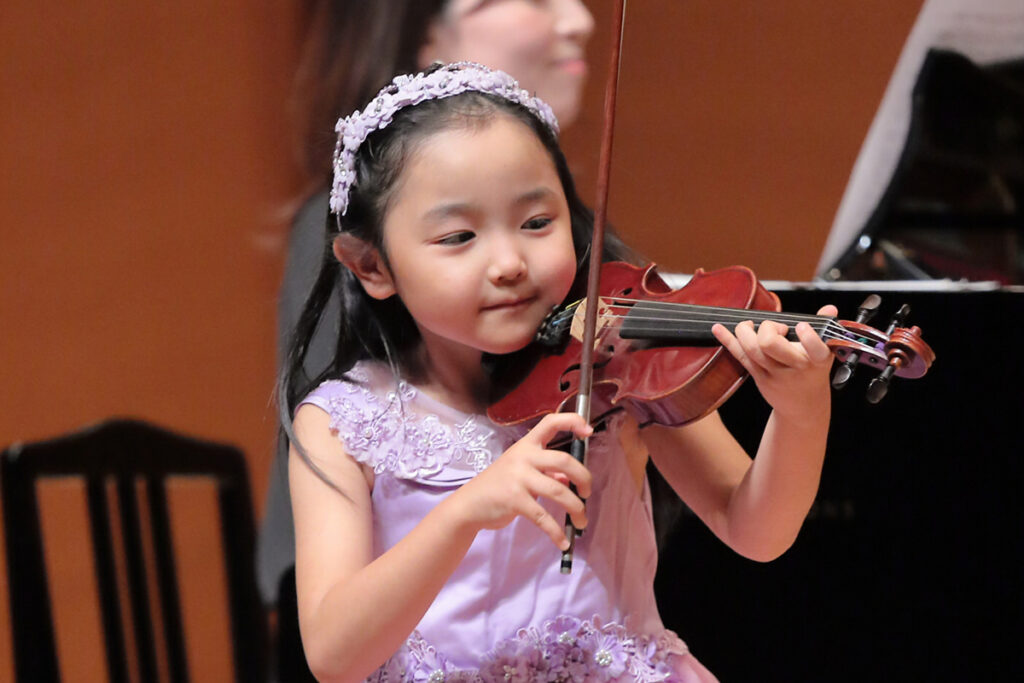
The students come together for periodically held recitals which move the hearts of their guardians.
The benefits of being exposed to music and musical instruments from infancy
1. It helps the brain to develop, stimulating inquiry and curiosity
Playing music, especially the violin or piano, requires the complex use of both the right and left brain. It is the ultimate form of brain exercise. Research shows that using both hands differently helps to develop focus, problem-solving and cognitive skills, as measured by IQ tests. These skills lay the groundwork for developing academic intellectual curiosity and further inquiry-based learning.
2. It develops non-cognitive skills and life skills
Our music school helps students to develop their working memory by engaging them in activities that involve reading music, listening and moving their fingers. Working memory involves storing information temporarily and recalling it later when necessary. This skill is closely correlated with human quotient (HQ), which encompasses problem-solving, social and creative skills. The non-cognitive skills necessary for a fulfilling life cannot be developed through just studying. Life skills developed through learning an instrument provide a foundation that will serve students well, no matter what the future holds.
3. It helps develop a sensitive ear that can be useful when learning English
Learning music can help students to develop their ability to analyse complex sounds, such as frequency, rhythm and harmony. Having a sensitive ear for sound will help them distinguish between nuanced sounds, which will help their Japanese-English bilingual education.
4. It fosters a sense of agency by strengthening their physical and social skills
Playing an instrument is a complex physical task which requires reading sheet music, playing the piano or strings, and listening to the notes. These activities activate neural pathways and improve physical abilities. Playing an instrument with others also helps children to develop agency by teaching them to cooperate and think for themselves.
5. It helps them express themselves which boosts their self-confidence
Students will learn to express themselves by putting their emotions into their performance, rather than just replicating what is written on the sheet music. Music is a way of expressing deep feelings that cannot be put into words. These skills will enrich their lives by boosting their self-confidence.
Music School Outline
| Contents | 30-minute private lessons with a dedicated instructor After class from 15:30~18:00 |
| Target | Students in kindergarten, elementary, secondary school at our school |
| Instrument | Violin or Piano |
| Number of times | Once a week (36 times per year) |
Recital
There are three times a year where students can show off their daily achievements: an ensemble at the entrance ceremony, the music recital, and at the Winter Celebration.
Lesson Content
Violin
The violin, with its beautiful tone and artistic form, can be played expressively with chords and vibrato.
There are also opportunities to play in ensembles with friends, teachers, and professional musicians, so you can learn the beauty of playing together.
Piano
The piano, which allows expression in a wide range of notes, is a comprehensive way to learn the fundamentals of music.
We may practice classical music, nursery rhymes, or even your child’s favorite songs for them to enjoy.
At the recitals, students can challenge themselves to play together with their parents, siblings, and teachers.